Night on Mt. Mizar
 The Pondering Pig is still pondering the Bible’s 42nd Psalm…
Verse 7. Deep calls to deep at the thunder of your cataracts; all your waves and your billows have gone over me.
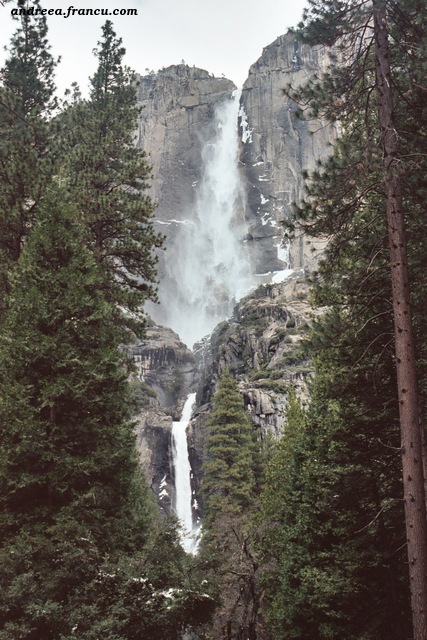
Oh boy, springtime in the mountains. Cataracts crashing. Being a native Californian, I think of Yosemite Valley. Did you ever read John Muir’s description of Yosemite Falls during snowmelt? I wish I had it here to quote from. What surge of joy, what exhilaration, with the mist rising and the comets of watersplash spinning off into the blue air.
We’re presented with a major contrast to everything that has led up to verse seven. It’s the third water image, and we’ve suddenly shot into another dimension where there is more wonderful living water than we can handle. And then in his wild skittering mind, the poet jumps even farther, into the Sea of Galilee maybe during a storm and he’s about to drown in God’s waves and billows. Pretty thrilling stuff, but I’m not quite sure how these images fit in to the rest of the psalm. And what does “deep calls to deep” mean, anyway? Is the cataract thunder calling to the thunder of the waves? That’s a cool image, but I’m not sure it’s what he meant. Can one of you thinkers help out? I’d like to know.
Guess I didn’t explain this one very well. I’ll try verse eight.
Verse 8. By day the Lord commands his steadfast love, and at night his song is with me, a prayer to the God of my life.
If I was the psalmist’s editor, I would write “clarify” in the margin. Or maybe the poet means to be ambiguous. It seems obvious that you can’t command someone to love you, so either the psalmist has a totally different understanding of what love means or, more likely, he means that God commands his love to go out to his people, sort of like the Holy Spirit – which hadn’t been given a name yet – and that God’s love is steadfast. Never stops. He loves his children forever no matter what.
“At night his song is with me”, is also a little ambiguous. Does the psalmist mean he remembers a song he used to sing in the temple and he sings it to God in his mind? Probably, but I like to imagine him in his sleeping bag up on Mt. Mizar, with his eyes open looking at the stars and he actually hears God singing in the night. Like Aslan.
Continued next post.
Thanks to Andreea Francu for the pic.
Labels: Meaning of Things, Psalms, Simple Justice
posted by Christopher Newton at 7:01 AM


8 Comments:
This comment has been removed by a blog administrator.
Oh - ok, READ THE WHOLE THING with credits before asking, right? Still a great photo.
Tried to make up for that gaffe by giving you the proper link to John Muir's descriptoin of Yosemite Falls. Didn't find exactly what I was looking for, but DID come across lots of great links to Muir stuff and Yosemite stuff.
Then I spent some time searching Psalms and thinking on that...
Now I really do need to go finish making that Zuccini bread I started...
No, buddy. You err. The Lord can command his love. It's up to the listener to respond. No one else, just his followers are commanded. The words aren't to the world here, as they are other places.
These are reflections of David. He's shepherd, warrior, adulterer, king, sinner, man who seeks after God's heart.
Well, maybe that covers most of us. I might be wrong. But I still contend that God's command is for believers.
As for the songs in the last verses, they are the lullabies that calms us. I think you're right. It's the song of peace we hear in our sleeping bags or gypsy wagons as we travel the world's road of the exiled.
I guess that's the lesson of the book of Exodus. They travelled 40 years on what was but a 3 day walk because they didn't hear the songs of the almighty at night. They had no peace because they did not pray for his peace.. No, they prayed for food and water and triumph over their enemies.
Not that those aren't important and fervent prayers to be made. They are of major import.
No, the first prayer should have been like David's psalm that you comment on here. A remembering of glories and distresses and final recognition of his ever-presence and ever-care for us.
David. He's my man. Better, he's God's man.
Leo, I'm curious about your conviction that David wrote this psalm. I don't see it, myself. Sure, he could have wrote it, but when I read it, I'm feeling like it's by another priest in another situation, as I've written.
The little inscription at the top of the psalm in my Bible simply says, "To the leader. A Maskil of the Korahites." A quick internet search indicates the Korahites were "an important branch of the singers of the Kohathite division", so sounds like this song was written to be sung in the Temple, strange it seems.
Here's my question: Why don't Christians ever sing the blues together in church, as the ancient Jews did? Praise is great, but the Hebrews took a more balanced approach. Just think about it. There is already a famous praise song based on "As the deer pantheth for the water" -- and it's based on exactly one verse of this psalm. Imagine a congregation singing together in unison, "My tears have been my food day and night!" Might be a little more meaningful than those nicey nice confessions by rote about "Awfully sorry that we're not quite as nice sometimes as we really ought to be. Tut tut. We really must do better."
You are correct. The sons of Korah wrote 11 psalms (42,44-49,84-85,87-88). I think of David when I read the Psalms because he is attributed with almost half of them. Also because, as king, he was the one who organized the service of worship in the tabernacle.
II Samuel 23:1 calls him the "sweet Psalmist od Israel". His influence is evident in many, if not the majority of the psalms.
Interesting to note that Solomon is author of 2 (72 and 127) and 90 is assigned to Moses. Besides those and the 11 that I mentioned above, a number are reportedly the writings of priests or levites in charge of music in worship. Something like 50, howvever, are attributed to no one in particular.
Mr. Pig, you should come to our church. Our worship guy has written quite a few "I can't do this" songs, "Why is this so hard?" songs, where we humble ourselves communally before the Lord. It's quite a different experience than roaring out "Onward Christian Soldiers"...but I think it's valuable!
I was thinking about your "blues" question too. ThenI remembered when I was young.
I grew up Catholic and then, as now, there is usually a responsorial reading, led by a commentator, and it is regularly a psalm, encompassing those lost emotions you were looking for. I believe it's the same in the Orthodox churches as well. In synagogue cantors regularly sing the blues.
I think it's just, generally, a piece our American Protestant ethic that tries to avoid the feelin' bad part.
In verse 8 where it says, "By day the Lord commands his steadfast love; and at night his song is with me, a prayer to the God of my life," I think the command is not for man to love God (although this is always needed), but, in agreement with your second comment, it is an acknowledgement by the psalmist that God is steadfast in his love.
I presume the words, "commands his steadfast love" in this verse are in the same sense as over in Psalm 44:26 (I can see this on the same page in my RSV Bible, and it caught my eye), where it says, "Rise up, come to my help! Deliver us for the sake of thy steadfast love."
As a side point: I believe God doesn't just have some love that he can option to express now and then, but, as it says at 1 John 4:8, "God is love." Therefore, when man expresses genuine love, he is giving animation to our God, who is the love being expressed. This is my good thought.
Post a Comment
<< Home